
This post contains affiliate links. If you purchase through our links, we may earn a small commission at no extra cost to you.
Going to the toilet is unavoidable. It is as certain as breathing.
My mom mentioned her knee pain recently. Almost in passing. This one comment sent me to search for the best raised toilet seats for seniors.
A regular toilet is still perfectly fine for most people. But when getting up and down starts to hurt — or needs to happen more often — it is worth knowing what options exist.
My first thought was simple: a raised toilet seat. Add a few inches, make it easier to stand up. Done.
I even had a visual reference — anyone who has watched Grace and Frankie will remember the episode where Grace engineers her own raised toilet seat contraption to launch herself off the bowl. Brilliant, if a little dramatic. I wanted something that worked without the catapult.
What I found when I actually started looking was more complicated than I expected. Some options wobbled. Some were nearly impossible to keep clean. Some created more problems than they solved.
This guide shares what I recommend, what I decided not to include, and how to pick the right option for your parent’s situation.
🟢 THIS GUIDE WILL HELP YOU LEARN:
- Which toilet safety styles actually work — and which ones I chose not to recommend
- The one cleaning problem most buyers don’t think about until it’s too late
- Why the style matters more than the brand
- How to match the right option to your parent’s specific needs
📌 What Is a Raised Toilet Seat for Seniors?
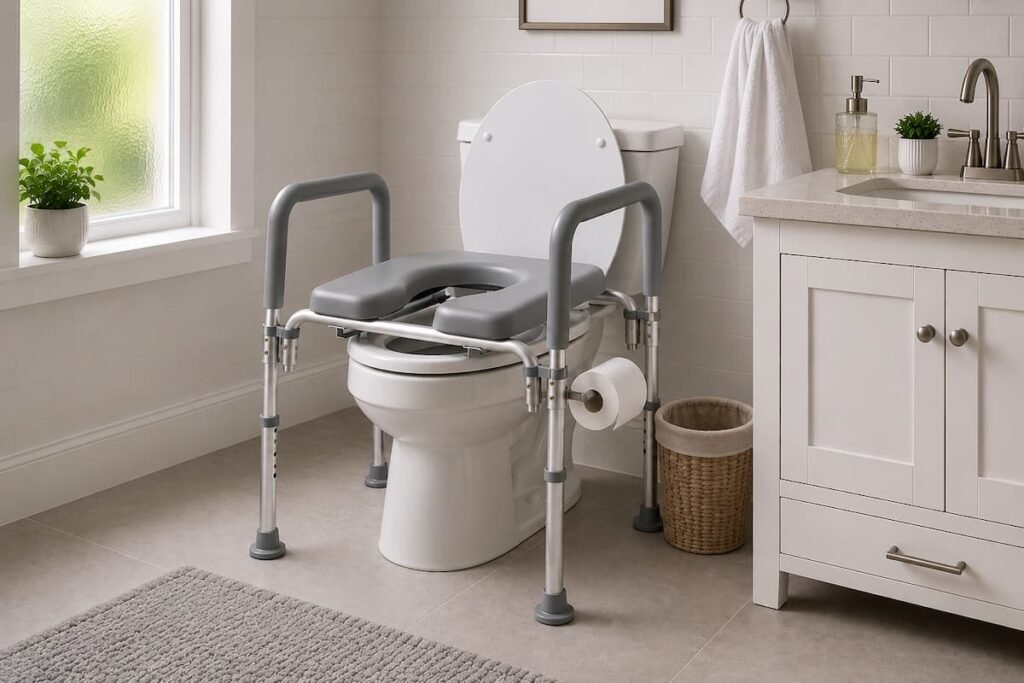
A raised toilet seat for seniors is a safety aid that adds height, support, or both to a standard toilet. It helps older adults sit down and stand up more easily — taking pressure off the knees, hips, and back. Options range from simple height risers to freestanding safety frames with handles.
⚡ Quick Answer: Our Top Picks at a Glance
- 🏆 Best Overall — Medical King: Highest rating, 400lb capacity, most affordable rail+seat option (~$49.99)
- 💰 Best for FSA/Warranty — Homland: FSA/HSA eligible, 1-year warranty, padded armrests (~$62.59)
- 🛡️ Best Freestanding Rail — Lianjindun: Easiest to clean, no crossbar, #1 Best Seller (~$43.59)
We only recommend two styles: freestanding safety rails and rail+seat combined frames. Scroll down to see why other styles did not make the list.
Why Toilet Safety for Seniors Matters More Than Most People Realize
Let’s be honest. Most people do not think about raised toilet seats until something happens.
A surgery. A fall. A recovery. A parent who suddenly cannot get up without help.
It is rarely a preventative decision. It is usually a reactive one — and that is completely normal.
There is also a practical reality that nobody talks about. A raised toilet seat or safety rail is not a one-person bathroom fixture. Spouses, visiting children, and grandchildren all use the same toilet. Adding a bulky frame to a shared bathroom is a real consideration — and for some families, not a comfortable one.
Aesthetics matter too. Not everyone wants clinical-looking equipment in their home. That resistance is valid.
But when the moment arrives — and for most aging parents it eventually does — you want to already know your options. You want to be ready without scrambling.
Toilet safety for elderly at home is not only about prevention. It is also about having a practical solution ready when the need becomes undeniable. That is exactly where this guide comes in.
The Best Raised Toilet Seats for Seniors — My Top Picks
I looked at dozens of options and read through hundreds of reviews before narrowing it down to three. I paid close attention to safety complaints, cleaning issues, and real-world fit problems.
What made it through are options I would genuinely consider for my own mom — practical, stable, and open about their limitations.
🏆 Medical King Toilet Safety Rail — Best Overall
Amazon’s Choice | Best Overall
⭐ 4.6 | 806 reviews | ~$49.99
Best for: Seniors who need both height and hand support — without a big budget
What I like:
- Fits both standard and elongated toilets (adjustable 21–25.5″)
- No tools needed to remove the seat for cleaning
- 400lb weight capacity — more than most competitors
- Amazon’s Choice with a 4.6 star rating across 800+ reviews
Assembly takes around 45 minutes. Like all rail+seat combined styles, the front crossbar sits closer to the body. This design works more comfortably for female users.
💰 Homland Toilet Safety Frame — Best for FSA / Best with Warranty
FSA Eligible | 1-Year Warranty
⭐ 4.5 | 1,490 reviews | ~$62.59
Best for: Seniors whose families want FSA/HSA coverage and added purchase protection
What I like:
- FSA/HSA eligible — offsets cost through pre-tax dollars
- One-year warranty — the only one in this style category
- Padded armrests — a small comfort detail that adds up over daily use
- Fits both standard and elongated toilets
Some reviewers report the rubber leg tips losing grip when handles are grabbed sideways rather than straight down. Also designed with a narrower opening — more comfortable for female users.
🛡️ Lianjindun Toilet Safety Rail — Best Freestanding Rail
Amazon # 1 Best Seller
⭐ 4.6 | 3,529 reviews | ~$43.59
Best for: Seniors who need standing support but do not need extra seat height
What I like:
- #1 Best Seller with 4.6 stars across 3,500+ reviews
- Lowest 1-star rate of all products reviewed — only 3%
- No seat means no cleaning issues and no crossbar discomfort
- 300lb weight capacity — solid for most users
- Lowest price on the list at $43.59
This rail does not raise the seat height. If your parent struggles specifically with the low position of the toilet, the Medical King or Homeland options above will serve better.
Best Raised Toilet Seats for Seniors Quick Comparison — At a Glance
| 🏆 Medical King | 💰 Homland | 🛡️ Lianjindun | |
| Price | ~$49.99 | ~$62.59 | ~$43.59 |
| Style | Rail + Seat Combined | Rail + Seat Combined | Freestanding Rail Only |
| Best For | Height + support on a budget | FSA/HSA users, warranty coverage | Support only, no height needed |
| Star Rating | ⭐ 4.6 / 806 reviews | ⭐ 4.5 / 1,490 reviews | ⭐ 4.6 / 3,529 reviews |
| Weight Capacity | 400 lbs | 400 lbs | 300 lbs |
| Raises Seat Height | ✅ Yes | ✅ Yes | ❌ No |
| Fits Elongated Toilet | ✅ Yes | ✅ Yes | ✅ Yes |
| FSA / HSA Eligible | ❌ No | ✅ Yes | ❌ No |
| Warranty | ❌ None listed | ✅ 1 year | ❌ None listed |
| Cleaning | Easy — seat removes without tools | Easy — seat removes without tools | Easiest — no seat attachment |
| Crossbar / Male Comfort | ⚠️ Front crossbar present | ⚠️ Front crossbar present | ✅ Not applicable |
| Assembly | ~45 min | Moderate | Quickest of the three |
| Stability / Grip | Good — minor wobble reports | Good — grip issues on sideways pull | Very good — lowest 1-star rate |
| Our Overall Take | Best value for height + support | Best for long-term peace of mind | Cleanest and simplest option |
The Medical King and Homland work best for female users due to the front crossbar design. If you are buying for a male user, the Lianjindun rail is the more comfortable choice.
How to Choose the Right Toilet Safety Aid for Seniors
There is no single right answer. The best choice depends on your parent’s specific situation. Here is what I looked at when narrowing down my options.
1. Does Your Parent Need Height, Support, or Both?
This is the first question to answer — before looking at any product.
A freestanding toilet safety rail adds grip and stability but does not raise the seat. It works well for seniors who are steady on their feet but need something to hold onto.
A rail and seat combined raises the toilet height and adds handles. It works better when getting up from a low position is the main struggle.
Getting this wrong means buying the wrong product entirely.
2. Does the Setup Need to Be Portable?
Some seniors share a bathroom. Some have caregivers who visit. Some may need to move the equipment between bathrooms.
A freestanding toilet safety rail with no seat attachment is the easiest to lift and reposition — no tools, no adjustment. The rail and seat combined is bulkier and better suited to a dedicated bathroom where it stays put.
If portability matters, factor it in before buying. It is easier to choose the right setup from the start than to swap it out later.
3. Weight Capacity — Do Not Skip This
Check the stated weight capacity before anything else.
Most options in this category support between 300 and 400 lbs. That range covers most users comfortably. But always verify — some products list different capacities on the packaging versus the product manual.
For heavier users, prioritize products with clearly documented 400lb weight capacity and consistent ratings for stability.
4. Cleaning — The Feature Nobody Thinks About First
This was my biggest surprise during research.
Some designs trap urine. Some have padded seats that stain permanently. Some are nearly impossible to wipe down properly after daily use.
For anyone managing toilet safety for elderly at home, cleaning is not a minor detail. It directly affects hygiene, dignity, and how long the product actually stays in use.
Look for seats that detach without tools. Avoid padded vinyl surfaces. Simple is better.
5. Fit — Not Every Toilet Is the Same
Standard and elongated toilets are different shapes and sizes. Not every adjustable toilet frame for seniors fits both.
Before buying, check whether the product explicitly states compatibility with your toilet type. The Medical King adjusts from 21 to 25.5 inches — one of the widest ranges available. That flexibility matters in older homes where toilet dimensions vary.
6. The Front Crossbar — Important for Male Users
This is the one design issue nobody puts on the product listing.
The rail and seat combined style has a crossbar that runs across the front of the frame. It is not a design flaw. It is structural — the seat rests on it and cannot exist without it. No brand making this style can remove it.
A curved crossbar could potentially solve it, but no brand has offered that yet.
For female users it is rarely an issue. For male users it sits directly in the way of normal anatomy during use. The complaints are consistent across every brand that makes this style — not because one brand does it poorly, but because the design itself has this limitation built in.
If you are buying for a male user, this style may not be the right fit regardless of brand. The freestanding toilet safety rail — no seat, no crossbar — is the more comfortable choice.
What I Looked At — And Decided Not to Recommend
I did not start this research with three products in mind. I looked at every style available before narrowing it down.
Here is what I found — and why certain styles did not make my final list.
Raised Toilet Seat Without Arms or Rails
This is the most basic option in the category. It sits directly on top of the existing toilet seat. No clips. No locks. No securing mechanism of any kind.
It is also the one that scared me the most.
The negative reviews across this style were not about minor inconveniences. They described the seat slipping off mid-use. Flying off upon sitting down. Throwing people directly onto the bowl, onto the floor — into genuinely dangerous and deeply embarrassing situations.
For a senior living alone — like my mom — that is not a risk I am willing to take. A product that is supposed to make the toilet safer should not create a new emergency.
Height without security is not a solution. It is a different problem.
Raised Toilet Seat With Arms
This style looks more promising at first glance. It adds height and bolt-on handles. On paper it addresses two problems at once.
But the bolt is where everything goes wrong.
When the raised seat is bolted onto the existing toilet seat, the bolt lifts the front of the raised seat upward. That creates a gap between the raised seat and the toilet bowl. That gap makes spillage during use virtually inevitable.
And then comes the cleaning problem.
To clean properly — the toilet, the seat, and the gap between them — the bolt has to be removed every single time. Then reattached. Then readjusted.
For someone who is elderly, managing pain, or dealing with limited mobility, removing and reinstalling a bolted seat regularly is not realistic. It is not a reasonable ask.
The result is a fixture that becomes difficult to keep clean, starts to smell, and creates an unhygienic situation over time. The very people who need this product most are the least able to maintain it properly.
That combination was enough for me to set this style aside entirely.
I also looked closely at one freestanding rail design that partially anchors to the toilet bowl using suction cups and side rods. The engineering intention was genuinely impressive — and it was one of my early candidates. But real-world reports showed the force of daily use gradually shifting the toilet itself, in some cases causing leaks. A toilet that moves is not a safe base for someone who depends on it for support. I made a deliberate decision not to include it. The three products I do recommend are freestanding — floor supported, no bolts, no bowl attachment, no permanent changes to your bathroom.
Common Mistakes to Avoid When Choosing Raised Toilet Seats for Seniors
1. Buying for the Wrong Problem
Height and support are two different needs. A rail with no seat does not help someone who struggles with a low toilet position. A raised seat with no handles does not help someone who needs something to grip.
Identify the actual problem first. Then find the product that solves it.
2. Choosing Based on Price — and Ignoring Stability
The cheapest option is not always the safest toilet safety aid for seniors. Some lower-priced styles rely only on friction or loose fitting instead of a true locking mechanism. Even a correctly sized seat can feel unsafe if it shifts during use.
Seniors lose confidence quickly after noticing movement. Locking mechanisms, clamp quality, and non-slip contact points matter more than most buyers expect. A product that creates a fall risk is not a bargain at any price.
3. Ignoring Weight Capacity
Not all raised toilet seats support the same amount of weight. Some lightweight models are only suitable for occasional assistance. Exceeding the stated weight limit can lead to wobbling, cracking, or sudden failure.
Always check the manufacturer’s listed weight limit — and verify it is consistent across the product listing, packaging, and manual. These do not always match.
4. Overlooking the Cleaning Reality
This is the detail most buyers miss until it is too late. Some styles trap urine in gaps that are nearly impossible to reach. Others have padded surfaces that stain permanently.
If the product cannot be kept clean without major effort, it will not stay in use. For a senior who cannot easily remove and reinstall components, cleaning difficulty becomes a hygiene problem fast.
5. Buying a Seat That Is Too High
More height is not always better. If your parent’s feet no longer rest firmly on the floor, balance and comfort can actually become worse.
The goal is easier sitting and standing — not creating a perched, unsupported position. Match the height to the user’s body, not to the maximum available option.
6. Assuming All Toilets Are the Same
Standard and elongated toilets are different shapes and sizes. Not every adjustable toilet frame for seniors fits both. Always check compatibility before buying — especially in older homes where toilet dimensions vary.
Frequently Asked Questions
The best raised toilet seat is one that feels stable, matches the user’s mobility needs, and fits the toilet correctly. Seniors who mainly need balance support often do best with a freestanding safety frame. Those who struggle with low toilet height may benefit more from a raised seat with handles and a secure locking system.
A toilet safety rail wraps around the toilet and provides handles to hold onto when sitting and standing. It does not raise the seat height. A raised toilet seat adds height but may or may not include handles. If your parent needs both height and support, a rail and seat combined style addresses both in one product.
They can reduce fall risk by making it easier for seniors to sit down and stand up safely. Models with sturdy handles or safety rails provide additional support during transfers. However, stability, proper installation, and bathroom layout all matter — no product eliminates risk entirely.
Most raised toilet seats add between 2 and 5 inches of height. The right height depends on the user’s mobility, leg strength, and comfort. A seat that is too low may still be difficult to use, while one that is too high can reduce stability if the feet no longer rest firmly on the floor.
Not always. Some raised toilet seats are designed for only one toilet shape. Before buying, check whether the product supports standard toilets, elongated toilets, or both. Adjustable-width safety frames are usually the most flexible option for different bathroom setups.
It depends entirely on the style. Freestanding rails with no seat attachment are the easiest — nothing to remove, nothing to disassemble. Rail and seat combined options are manageable if the seat detaches without tools. Avoid any style that bolts onto the existing toilet seat — the gap it creates makes hard-to-reach areas difficult to clean thoroughly.
Yes. Raised toilet seats are commonly recommended after hip replacement or knee surgery because they reduce the need to bend deeply when sitting down or standing up. Many doctors suggest them during recovery. Always confirm the recommendation with your medical provider before purchasing.
Yes. Some models are designed with reinforced frames and higher weight capacities. Always check the manufacturer’s listed weight limit before purchasing — and verify that the number is consistent across the product listing, packaging, and manual, as these do not always match.
Some are, some are not. FSA and HSA eligibility varies by product and retailer. Always verify eligibility directly on the product listing before purchasing as FSA and HSA rules can vary by plan.
Not Sure Where to Start?
That is completely normal. There are more options out there than most people expect — and the differences between them are not always obvious at first.
Here is a simple way to think about it.
If your parent mainly needs something to hold onto — but the toilet height is not really the issue — start with the freestanding toilet safety rail. It is the simplest, cleanest option with the least disruption to the bathroom.
If getting up from a low position is the main struggle, the rail and seat combined style addresses both height and support in one unit. It is the most practical choice for a senior living alone.
If budget is the first concern, the most affordable option on this list still meets the essential toilet safety for elderly at home requirements without compromise on the basics. You do not need to get this perfect. You just need to get started. One small change can make a meaningful difference.
What to Read Next
The toilet is one piece of a larger picture.
If you are thinking about bathroom safety more broadly, a good next step is to look at the rest of the space — not just the toilet. Grab bars, shower chairs, and non-slip bath mats each address a different risk in the same room.
Here are a few resources that might help:
- 🛁 Best Shower Chairs for Seniors — if your parent needs seated support in the shower
- 🤚 Best Grab Bars for Seniors — for support getting in and out of the bath or shower
- 🧼 Best Non-Slip Bath Mats for Seniors — the easiest upgrade for any senior bathroom — no installation required
- 🏠 Bathroom Safety for Elderly Parents — a broader look at bathroom fall prevention and where to start
- ✅ Free Home Safety Checklist — a simple room by room checklist you can work through at your own pace
- 🛒 Bathroom Safety Products — all recommended products in one place
You do not have to tackle everything at once. Most families start with one room and one product. That is enough to begin.