
This post contains affiliate links. If you purchase through our links, we may earn a small commission at no extra cost to you.
What Is the Best Night Light for Seniors?
The best night lights for seniors are automatic plug-in lights that help older adults safely move through the home at night. The safest options use motion sensors or dusk-to-dawn sensors to provide soft, warm lighting without requiring switches, harsh overhead lights, or constant maintenance.
Getting up at night should not feel dangerous.
But for many older adults, it does.
Poor nighttime lighting is one of the most common causes of falls at home, especially on the short walk between the bedroom and bathroom.
As we age, our eyes need more time to adjust to darkness. Depth perception changes too. Shadows become harder to judge. Even familiar hallways can suddenly feel disorienting when someone wakes up half asleep at 2am.
That small moment between waking up and seeing clearly is where accidents happen.
I put this guide together for my mom. She is 80, lives alone, and is still fiercely independent. She does not see the need to make the house any different from how it has always been. But a small plug-in night light? So subtle and effortless — nothing to object to.
And honestly, that matters. Sometimes the best safety changes are the ones a parent willingly accepts.
In this guide, you’ll learn:
- Which type of night light works best for seniors
- Where to place lights for the safest nighttime path
- What features actually matter — and what to skip
- Our 2 top product picks that we feel comfortable recommending
- Common mistakes that still leave dangerous dark spots
- how to create softer nighttime lighting without making the home feel institutional
Why Night Lights Matter for Senior Safety
A good night light does more than help someone see in the dark.
It creates:
- a visible walking path
- softer transitions between darkness and light
- less fumbling for switches in the dark
- fewer harsh overhead lights that fully wake someone up
When my dad became weaker, we slowly started making safety changes around the house. Some were larger — a grab bar, a shower chair. Others were much smaller.
I noticed that my parents’ house felt completely different at night than during the day. In daylight, everything looked familiar and easy to navigate. But late at night, even a short hallway suddenly felt darker and less steady than I expected.
Night lighting turned out to be one of those surprisingly important small changes.
🔎 Did You Know?
Falls are the leading cause of injury-related death among adults 65 and older in the US. In 2021, falls caused more than 38,000 deaths — and poor nighttime lighting is one of the most common, most preventable contributing factors.
How Aging Eyes Change at Night
As I started researching home safety more carefully, I learned that seniors’ eyes process darkness differently.
As we age:
- pupils become smaller and let in less light
- contrast sensitivity decreases
- depth perception changes
- adapting between dark and light becomes slower
I used to assume brighter automatically meant safer. But that is not quite right.
Overly bright lighting can feel disorienting when someone first wakes up at 2am. Harsh overhead lights are not always the answer. A softer, gradual glow is often much easier on aging eyes.
Types of Night Lights for Seniors
Not all night lights work the same way. Understanding the difference makes it much easier to choose the right setup.
Motion Sensor Night Lights
Motion sensor night lights turn on automatically when movement is detected and switch off after a short period.
These work especially well in hallways, bathrooms, stairways, and entrances between rooms. Nobody has to remember switches, buttons, or cords in the dark. For seniors with arthritis, balance issues, or limited mobility, that matters more than people realize.
Dusk-to-Dawn Night Lights
Dusk-to-dawn lights turn on automatically when the room becomes dark and stay on until morning.
These are often best for bedrooms, staircases, and seniors who feel anxious in the dark or who have dementia. A constant soft glow can feel calmer and more reassuring than a sudden motion-triggered light.
Motion + Dusk-to-Dawn Combination
For most homes, this combination is ideal. These lights activate only when the room is dark and movement is detected. That creates a safer path while keeping the house comfortably dark for sleep.
Battery-Operated or Rechargeable Night Lights
Rechargeable night lights can be useful where there is no nearby outlet. But personally, I would not rely on them as the primary lighting system for a parent living alone. Dead batteries create invisible safety gaps. Battery-operated lights work best as supplemental or backup lighting — not the main nighttime safety system.
Quick Answer: Best Night Lights for Seniors
If you want the short version, these are the three night lights I would personally consider first for the bedroom-to-bathroom path.
- ⭐ Best overall: AUVON Plug-in LED Night Light
- 💰 Best value: MAZ-TEK Dusk-to-Dawn 6-Pack
For most families, the safest setup includes:
- one light beside the bed
- one in the hallway
- one at the bathroom entrance
That simple path covers the area where most nighttime falls happen.
Best Night Lights for Seniors: Our 2 Top Picks for the Bedroom-to-Bathroom Path
There are hundreds of night lights online. Most look almost identical. After researching reviews, brightness levels, reliability, sensor performance, and ease of use, these are the options that stood out most for senior safety.
⭐ Best overall: AUVON Plug-in LED Night Light
⭐ 4.8 stars | 3,174 reviews | Amazon’s Choice | $13.98 for a 2-pack (~$7.00 each)
Best for: Reliable bedroom-to-bathroom lighting
What I like:
- motion sensor and dusk-to-dawn sensor combined
- 5 adjustable brightness levels
- soft warm white light that does not feel harsh at night
- automatic operation with almost no maintenance
- 24-month warranty — the longest in this category
This is the one I would personally place in my mom’s hallway. It feels simple in the best way possible. Once installed, it quietly does its job without anyone needing to think about it.
That kind of reliability matters when a parent lives alone. I know myself well enough to know that anything requiring constant charging or resetting eventually becomes one more thing to remember. I would rather have something my mom never has to think about at all.
💰 Best value: MAZ-TEK Dusk-to-Dawn 6-Pack
⭐ 4.8 stars | 5,835 reviews | Amazon’s Choice | $9.99 for a 6-pack (~$1.67 each)
Best for: Covering the whole bedroom-to-bathroom path affordably
What I like:
- affordable 6-pack — covers bedroom, hallway, bathroom, stairs, and more
- soft warm glow all night — no sudden switching
- no complicated settings
- especially calming for seniors who dislike sudden light changes
If you are starting from scratch and need lighting in multiple rooms, this is probably the easiest option. One order can usually cover:
- bedroom
- hallway
- bathroom
- stairs
- kitchen
- entryway
Sometimes the simplest setup is also the one most likely to get installed quickly.
A Quick Note About Rechargeable Night Lights
I also researched rechargeable options. Flexible placement is genuinely useful, especially in older homes where outlets are limited.
But I noticed the same concern appearing repeatedly in reviews: batteries draining faster than expected. That may not matter much in a busy family household. But for a parent living alone, a forgotten recharge can quietly create a dangerous dark area. For that reason, I personally see rechargeable lights as a secondary solution rather than the main nighttime safety system.
Quick Comparison: Best Night Lights for Seniors
Not sure which one is right? This table makes it easy to decide at a glance.
| AUVON | MAZ-TEK 6-Pack | |
| Best For | Reliable path lighting | Whole-home coverage |
| Sensor Type | Motion + dusk-to-dawn | Dusk-to-dawn only |
| Light Colour | Warm white | Warm white |
| Brightness Control | 5 preset levels | Fixed soft glow |
| Pack Size | 2-pack | 6-pack |
| Price Per Unit | ~$7.00 | ~$1.67 |
| Maintenance | None | None |
| Warranty | 24 months | 12 months |
| Star Rating | ⭐ 4.8 (3,174) | ⭐ 4.8 (5,835) |
| Our Overall Take | Best overall for peace of mind | Best value for whole-home coverage |
Where to Place Night Lights for Seniors
Choosing the right night light matters. But placement matters just as much.
Most nighttime falls do not happen because the house has no lighting at all. They happen because one part of the path is still dark.
The goal is simple: create a continuous line of soft lighting from the bed to the bathroom and back again. Every room below connects back to that same journey.
Bedroom Night Light Placement
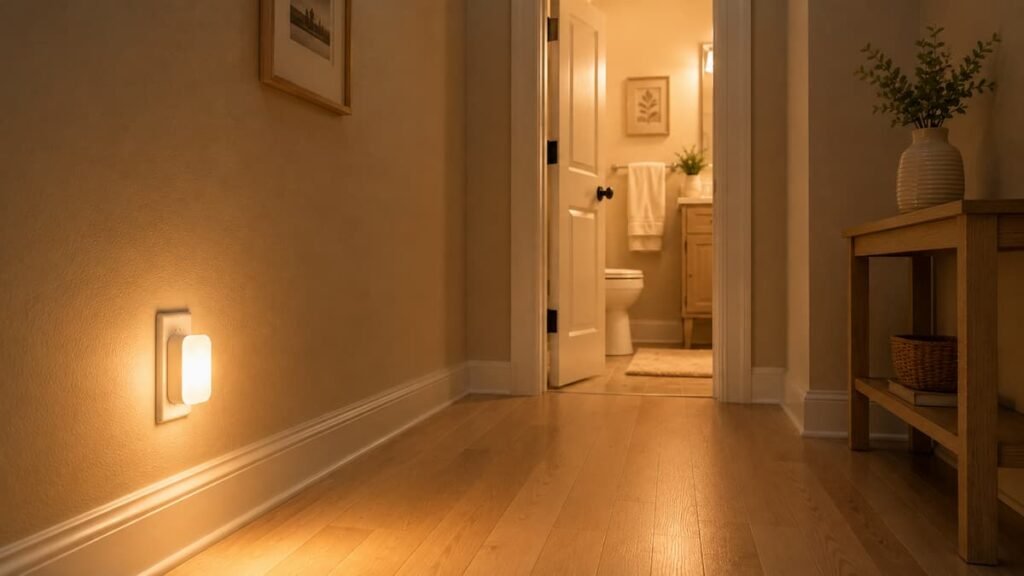
Place the light low on the wall near the side of the bed your parent actually uses.
The room should already feel softly illuminated the moment their feet touch the floor. Avoid placing the light behind furniture, across the room, or too high on the wall.
Low placement works best because the glow spreads across the walking surface instead of shining directly into the eyes.
Hallway Night Light Placement
Hallways are often the most overlooked part of nighttime safety.
Many people place a light in the bedroom and another in the bathroom while leaving the middle completely dark. I noticed this in my parents’ house — the bedroom and bathroom were lit, but the hallway between them still felt strangely dark at night. That middle stretch mattered more than I realized.
For hallways: place one light midway between rooms, use two lights for longer hallways, and keep lights at outlet height whenever possible. The safest path feels continuous, not patchy.
Bathroom Night Light Placement
The bathroom should already feel visible before someone fully enters the room.
Place one light near the bathroom entrance and another near the toilet if an outlet is available. Avoid placing lights behind the bathroom door or in corners where the light gets blocked.
If the bathroom floor has glossy tile, softer lighting usually works better than bright glare.
Stairway Night Light Placement
If your parent uses stairs at night, proper lighting becomes even more important.
Place night lights at the top of the stairs, at the bottom, and at landings if the staircase turns. The first step down and the final step up are often the most dangerous moments.
Small Homes vs Larger Homes
Smaller apartments sometimes need fewer lights than people expect. Larger homes often need more than families initially realize.
A good rule: if any part of the nighttime path still feels shadowed, add another light.
How to Choose a Safe Night Light for Elderly Parents
There are hundreds of night lights available online. Most are not designed with seniors specifically in mind. These are the features that actually matter.
1. Automatic Operation
This is probably the most important feature. The safest night lights work automatically — no buttons, no switches, no remembering.
For seniors with arthritis, mobility issues, balance problems, or dementia, even small extra steps increase risk.
2. Warm White Light
Look for warm white lighting around 2700K to 3000K. Warm lighting feels calmer and less disruptive to sleep.
Avoid cool white LEDs, daylight bulbs, and harsh blue-toned light. Those brighter tones can feel startling at night and may make it harder to fall back asleep.
3. Gentle Brightness — 20 to 70 Lumens
Brighter is not automatically safer. The goal is safe visibility, not fully lighting the room.
Generally, around 20 to 70 lumens works best for nighttime navigation. Adjustable brightness is especially useful when different rooms need different light levels.
4. Plug-In Models Over Battery Models
Plug-in lights require almost no maintenance. That matters more than most people think — especially when caregiving already involves remembering medications, appointments, groceries, and a hundred other things.
Anything that relies on charging or battery replacement eventually gets forgotten.
5. Multi-Pack Coverage
One night light rarely solves the problem. For most homes, you need at least one near the bed, one in the hallway, and one in the bathroom.
A multi-pack often provides better value and much better coverage than buying individual lights.
Common Night Light Mistakes That Leave Seniors at Risk
Buying Only One Light
One light only protects one area. The dangerous spots are usually the dark gaps between rooms. Plan for the whole path from the start.
Choosing Bright White LEDs
Many LEDs appear softer online than they do in real life. At 2am, harsh white light can feel jarring and disorienting. Warm white lighting is almost always the better choice.
Relying Entirely on Rechargeable Lights
Rechargeable lights are helpful additions. But they should not be the only nighttime lighting system protecting a parent who lives alone.
Placing Lights Too High
Night lights work best low to the floor. That keeps the walking surface visible without creating glare.
Forgetting the Hallway
This is probably the most common mistake. The hallway between the bedroom and bathroom is often the darkest part of the entire nighttime path.
Frequently Asked Questions About Night Lights for Seniors
The best night light for seniors is usually a plug-in model with motion sensor and dusk-to-dawn functionality combined. Warm white lighting and automatic activation make nighttime movement safer without disturbing sleep
Place night lights along the full bedroom-to-bathroom path: beside the bed, in the hallway, at the bathroom entrance, and near stairs if needed. The goal is continuous lighting without dark gaps.
Yes. Poor nighttime visibility is one of the most common causes of falls at home. A well-placed night light reduces the need to walk through darkness or search for switches while half awake.
Warm white light around 2700K to 3000K is usually the safest choice. It provides enough visibility for safe movement while remaining softer on aging eyes and less disruptive to sleep.
It depends on the person. Motion sensor lights work especially well in hallways and bathrooms. Dusk-to-dawn lights are often better for seniors who feel anxious in darkness or wake frequently during the night. Many homes benefit from using both.
Not Sure Where to Start?
That is completely okay. Most families do not change the entire house overnight.
The safest approach is usually to start with the one nighttime path used most often. For many homes, that means bedside, hallway, and bathroom.
If I were starting with just one product, I would probably choose the AUVON and place it either beside the bed or in the hallway. One small improvement can make nighttime movement feel immediately safer.
And emotionally, starting small often feels easier for everyone involved. A plug-in night light feels very different from making a major bathroom modification or bringing up mobility concerns directly. That is how most home safety changes happen. Not all at once. One thoughtful step at a time
More Ways to Make a Home Safer for Aging Parents
Night lights are a great first step. But they work best as part of a broader home safety plan.
The bathroom is still the highest-risk room in most homes. That is where I personally started paying closer attention after watching my dad become less steady over time.
Small changes made earlier tend to feel easier and less overwhelming. Preparing early is usually calmer than scrambling after a fall or hospital stay.
Other areas worth reviewing:
- Bathroom Safety Guide →
- Best Grab Bars for Seniors →
- Best Non-Slip Bath Mats for Seniors →
- Best Shower Chairs for Seniors →
- Best Raised Toilet Seats for Seniors →
- Free Home Safety Checklist →
Coming soon from Zenlora:
One room at a time.
You do not need to change everything at once. Most families start with one room and build from there. Small changes, done consistently, add up to a much safer home.
Final Thoughts
A night light may seem simple.
But when it quietly helps someone move safely through the house at 2am without fear or confusion, it becomes much more important than it first appears.
That is what I keep reminding myself with my own mom.
You do not need the perfect setup all at once.
You just need a safer next step.
Zenlora
Safe. Independent. At Home.